Coffee 101
How to rate a coffee shop: five scores, not one star.
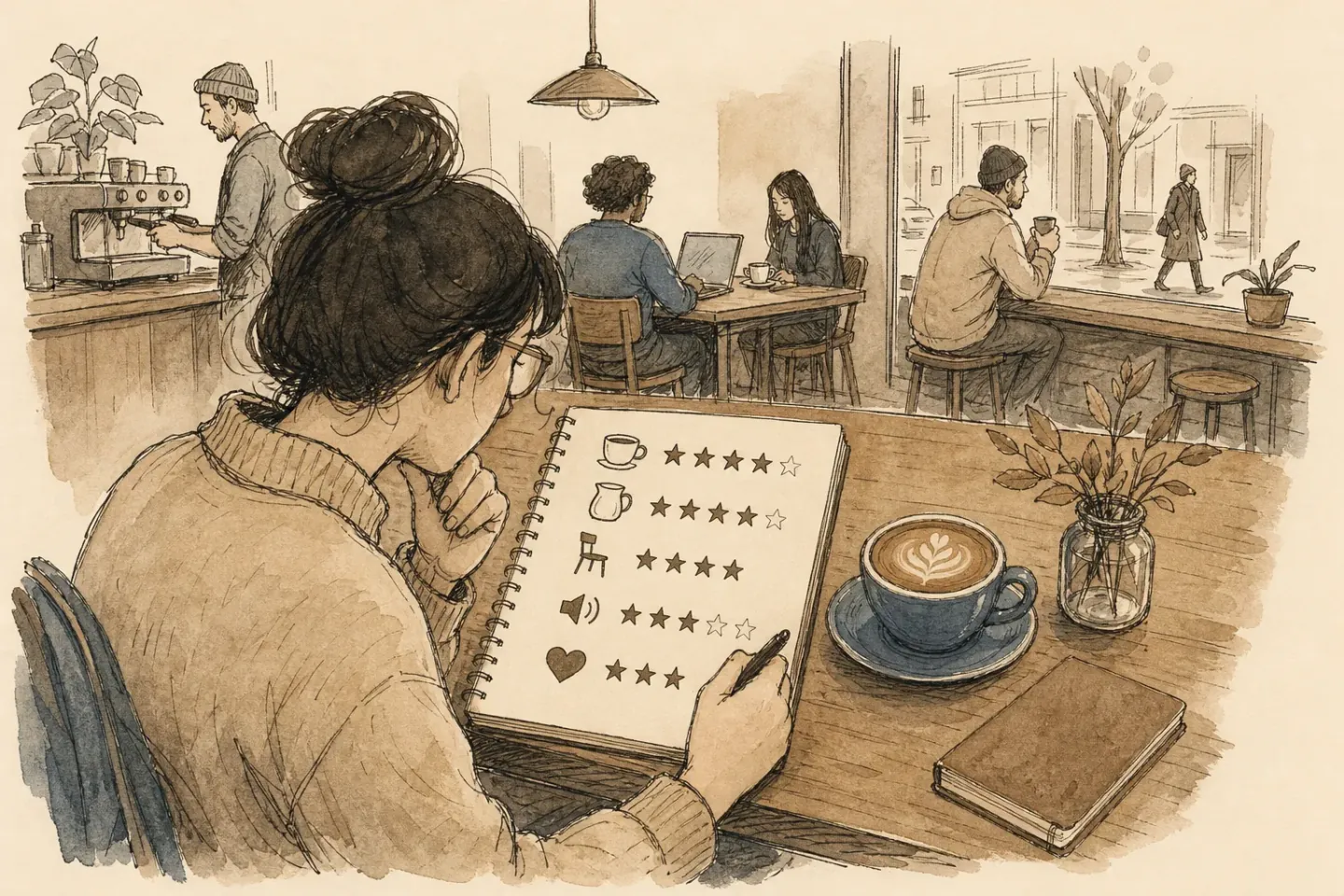
Rate a coffee shop on five things, not one star: the cup, the milk, the seat, the noise and the feel. Score each from 1 to 5. Five small scores still mean something six months later. One star doesn't.
You're standing outside that place on Queen. You gave it four stars in March. Was it the flat white, or the window seat? Can you work there for three hours, or just grab a cup? The four doesn't say. Your memory fills in the gap, and it fills it in wrong.
Why one star stops working
One number has to hold everything at once. A café can pour a great flat white and still have no seat you could work from for an hour. Those are two facts. A single star can only keep one of them.
A stranger's 4.6 has the same problem, only bigger. It averages people who came on a quiet Tuesday with people who came in the Saturday rush. Some came for the espresso, some for the patio. The number can't tell you which ones were like you.
The five scores
We use the same five every time. Each one answers a question you'll ask later.
1. The cup
Start with the espresso. A good shot tastes sweet and round, with a clean finish. Sharp and sour usually means it ran too fast. Harsh and bitter usually means it ran too long. If you order the same drink everywhere, the cup scores are fair to compare.
2. The milk
This is where a lot of cafés lose a point. Good milk is silky and glossy, with bubbles too small to see. It mixes with the coffee instead of sitting on top as a stiff cap. Take a sip near the end. If the coffee has gone and only warm milk is left, that's a lower score.
3. The seat
Score the seat as a practical question, not a pretty one. How long could you sit there before you shift around? Can you reach an outlet from it? A lovely bench you can't stay on for an hour is a 2 if you came to work.
4. The noise
Here's a simple test. If you'd have to raise your voice to talk across the table, it's too loud for a call. Noise changes with the hour. A café at 11 a.m. on a Tuesday and the same café on Saturday morning are two different places. So write down when you were there.
5. The feel
This is the hardest one to put into words. Ask one question: did you want to stay, or finish the cup and go? Light, music, how full it felt and how calm the staff were all go into it. Give it a number anyway. A feeling with no number is gone in a month.
What each number means
A scale only works if the numbers keep their meaning. A 4 here should mean the same as a 4 across town. These are the anchors we use:
- 1: You wouldn't go back if anything else was close.
- 2: Real problems you'd have to work around.
- 3: Fine. Nothing wrong, nothing you'll remember.
- 4: Clearly good. You'd send a friend.
- 5: You'd change your route to come back.
Weight the score you came for. If you came for the cup, the cup counts most. If you came to work, the seat and the noise do.
Write it down before you leave
Score it while the cup is still on the table. By the next day, two of the five will be a guess. Add the day and the hour, since that's what moves the noise and the seat the most.
Keep the scores to yourself. On a public page, you round a 3 up to a 4 because the barista was nice. When nobody else reads it, you can give a lovely patio a 2 for the coffee. That honest 2 is the one that helps you later.
Where kava fits
In kava, each café gets a rating and a note. The five scores are something you write in that note yourself. Ours look like this: "cup 4, milk 5, seat 2, noise 3, feel 4. Tue 11 a.m." Two taps to add the café, one line for the note.
Anything else that matters goes in the note too, like "good for three hours". Your ratings are visible only to you, with no public feed and no followers. So you can give a neighbourhood staple a 2 for seating without worrying about anyone's feelings. That 2 may save you from planning a three-hour work session there four months from now. Your map also shows the cafés nearby you haven't tried yet, turning the blank spots into a quiet invitation. That's where the next 5 is.
One thing to try this week
At the next café you try, write the five scores before you stand up. Just one café. Next time you walk past it, you'll know exactly why you'd go back, or why you'd try the one next door.
Questions
How should I rate a coffee shop so the score is still useful months later?
Use dimension-based scoring instead of a single star: rate several distinct criteria on a 1–5 scale and log the scores before you leave. Note the time and day of the visit so future you knows the context (a quiet Tuesday vs. a busy Saturday). Making the habit of recording separate dimensions creates an actionable personal record you can trust later.
What should I check when rating coffee quality (espresso and milk)?
Judge the espresso for a well-extracted shot that is sweet, rounded, and balanced with lively acidity and a clean finish rather than sharp sourness or harsh bitterness. Check body: smooth and slightly viscous is good, and watch how the coffee stays perceptible as it cools. For milk, look for silky, glossy microfoam that integrates with the espresso rather than sitting as a stiff cap.
How do I rate seating and power outlet availability?
Rate seating practically: how long can you stay without shifting and is there enough table space and comfortable chairs for your purpose. Also record whether outlets are accessible from where you sit, since accessibility of power is a major driver of repeat visits regardless of how charming the furniture looks.
How should I rate noise level at a café?
Rate noise in context by noting the visit time and day, because a café can be quiet midweek and loud on weekends. Use acoustic benchmarks as a guide: around 50–60 dBA is comfortable for focused work, while about 70–75 dBA becomes borderline disruptive. Score based on how the actual noise affected your experience. Mentioning the time of day alongside the noise score makes the rating actionable.
What does 'vibe' mean and how do I score atmosphere?
Vibe is whether the place feels like somewhere you want to stay or somewhere you want to leave; translate that instinct into a number. Consider lighting, music volume, crowding relative to space, and whether staff seem relaxed or frantic, then rate how those factors make you feel about staying. Turning that feeling into a numeric score prevents it from being forgotten.
Should I track service, cleanliness, or value too, or stick with the five dimensions?
The article recommends five core dimensions as a strong starting point, but other systems include service, cleanliness, value, and accessibility. Track those additional categories if they matter to how you use cafés; they’re useful add-ons but not required for a practical personal checklist.